


Printed solar panels make buildings more colourful and sustainable

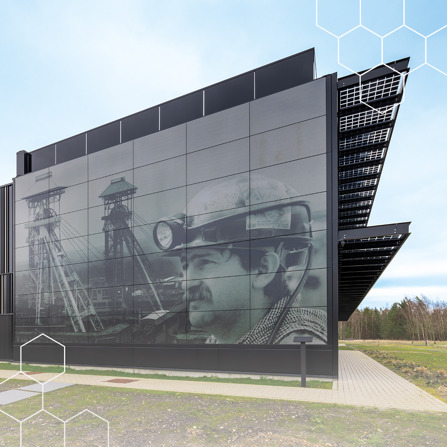
Innovation project Circular Multicolour Facade PV Factory has been officially launched. Led by Kameleon Solar, a chain-wide, integral approach is being developed for sustainable, safe, multi-color solar panels in facades.
The 'Circular Multicolour Facade PV Factory' project is receiving 1.4 million grant through the European innovation program OPZuid, with co-financing from the central government and the province of North Brabant. 'The grant will be used to make the total production line of colored, building-integrated solar panels (bipv) more future-proof,' says Kevin Verpaalen, general director of Kameleon Solar. 'To realize that, we have 3 focus areas. First is the design software. In collaboration with Brainstorm and Concept and Sioux Technologies, we are developing a user-friendly portal, in which architects can design panels themselves and enter the color, size and placement on the facade. They can then immediately see what impact design decisions have on the efficiency of the solar facade. The architect's input can go directly into the production line. We are also working on a link with the software of BIPV.world - which, like BIPV Projects, is a project partner - to efficiently and effectively design an entire facade or complete building with solar panels. That design is immediately translated into insight into the costs and revenues of the entire solar facade. Through this platform, you realize a safe PV facade easily and cost-effectively.'
Recyclable or reusable
Another focus area concerns the sustainability of the solar panels themselves. Here Kameleon Solar, together with project partner TNO and Biosphere Solar, is investigating new ways to glue solar panels so that at the end of their lifespan they can be disassembled and therefore recyclable or even reusable.
'The goal is to develop a way to do that on a large, industrial scale,' Verpaalen points out.
Quality tester
'This is a tremendously interesting project for us,' says Peter Toonssen of TNO. 'We will soon be able to apply the technological development in the field of removable or releasable adhesives to other PV fields. That will bring the full recyclability of Dutch PV solutions much closer again.'
The final point of interest concerns the quality of colored solar panels. Verpaalen: 'There are now few specific quality requirements for colored pv panels, while you can imagine that it is very difficult to check a PV panel with an image for delamination or air bubbles, for example. We can test and really prove that our colored solar panels have even higher quality, lifetime and fire safety than standard solar panels. Therefore, together with Rimas, Steinfort Glas, Sioux Technologies and TNO, we are going to develop a special quality tester or series of quality tests specifically for different types of colored solar panels.'

Other Articles Title
-

Bringing high-tech expertise to space at ESA Industry Space Days
On 16 and 17 September, Sioux Technologies will be at the ESA Industry Space Days at ESA/ESTEC in Noordwijk, organized by Business with ESA. The event brings together organizations from across the European space sector to exchange knowledge, explore business opportunities, and connect with potential partners. -

Exploring the future of microscopy at IMC21
From 31 August to 4 September, Sioux will be at IMC21 in Liverpool to connect with researchers, technology companies, and industry experts about the developments shaping the next generation of microscopy. -

Sioux officially opens new office in India
Sioux Technologies has celebrated the official opening of its new office in Pune, India, further strengthening our international engineering network.